



01 May 2026
TRI-PhD SALON Kick-Off Symposium Event Report
![[Event Report] TRI-PhD SALON: New Industry-Academia-Government collaboration focuses on international PhD talent](/sites/default/files/styles/background_image_xl_2x/public/2026-05/TRIPhD%20picture1_0.jpg?h=c82f6800&itok=0ZVoiFBL)
[Event Report] TRI-PhD SALON: New Industry-Academia-Government collaboration focuses on international PhD talent
On April 27, 2026, the Kick-off Symposium of the International PhD Talent Recruitment and Development Salon (TRI-PhD SALON) was held at AP Inogate Osaka. While the venue capacity was set at 70, more than 100 participants registered, and the atmosphere was charged with anticipation well before the program began.
The "TRI-PhD SALON" (Triple-Helix Roundtable for International PhD Talent) is a platform for mutual learning where Industry, Academia, and Government sectors intertwine like a triple helix. Its mission is to share challenges and expertise to empower international PhD talent, transforming them into a driving force for Japanese innovation.
A Salon Born from Conviction
In the opening remarks, Naoya Taniguchi (NAIST), Representative of TRI-PhD SALON, shared a strong and deeply held conviction: the need to cultivate the soil itself—an environment in which international PhD talent can truly thrive within Japanese society.
Moving beyond discussions of matching mechanisms or institutional frameworks alone, he spoke of a shared sense of urgency and commitment that began at the grassroots level and grew through collective empathy and agreement. This origin story of the salon embodied precisely the kind of co-creation it seeks to foster. His message set a focused tone for the day, catalyzing lively discussions centered on a common question: what can each of us do?
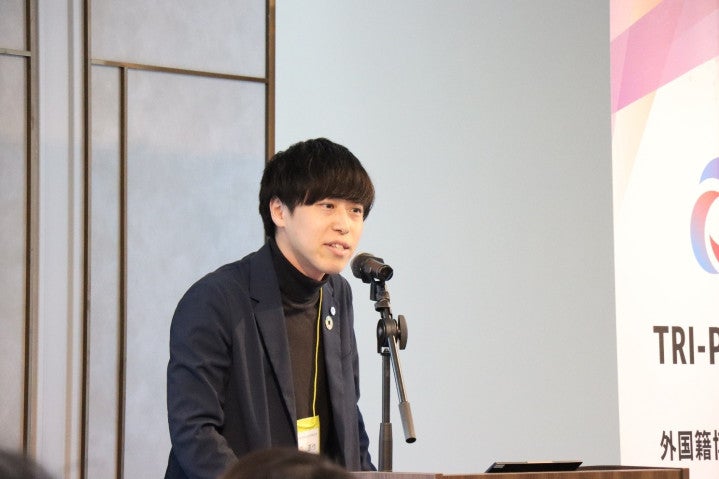
Naoya Taniguchi (NAIST) delivers the opening remarks and outlines the purpose of the event. (Photo credit: NAIST)
Endorsement from Industry and Government
In the following guest remarks, Kenji Saito (JETRO) emphasized the salon’s potential role as a practical hub connecting highly skilled global talent with intellectual property, commercialization, and international networks.
From a policy perspective, Yasuko Kumaki (Cabinet Office of Japan, STI Promotion Secretariat) reframed PhD holders as drivers of innovation and social transformation rather than solely as researchers. Together, these messages clearly positioned TRI-PhD SALON as an initiative supported from both implementation (industry) and institutional (government) standpoints.
Diversity as a Source of Strength
In the keynote address, President Kazuhiro Shiozaki (Nara Institute of Science and Technology) spoke on the theme “Power of Diversity,” articulating how diversity underpins co-creation and innovation. He highlighted that the problem-solving abilities and multifaceted skills cultivated through doctoral training are no longer confined to academia, but are essential assets across society.
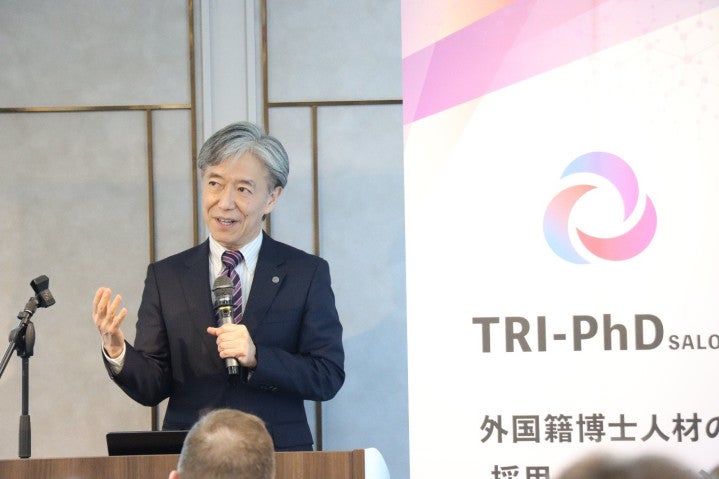
Kazuhito Shiozaki, President of NAIST, discusses the fundamental power of diversity based on his personal experience studying abroad and innovation through interdisciplinary research. (Photo credit: NAIST)
This was followed by a program overview from Aya Puca (OIST), who presented the salon’s vision and concrete action plans. By bringing universities, companies, and public institutions together, TRI-PhD SALON aims to create a society in which diverse PhD talent—regardless of nationality or language—can settle in Japan and fully realize their potential.
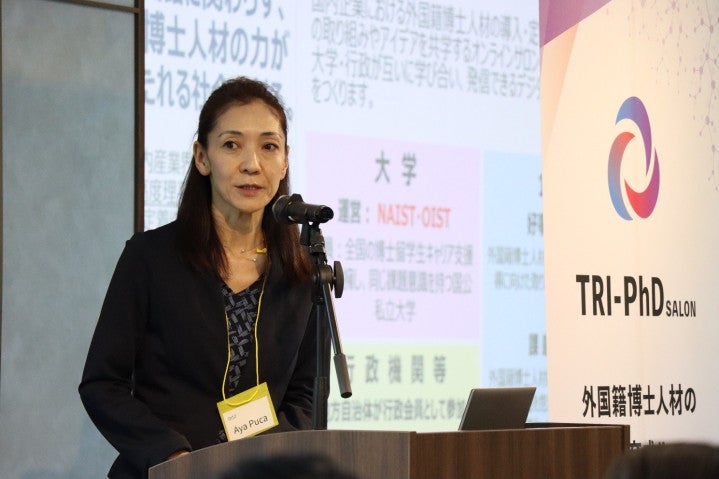
Aya Puca of OIST, Deputy Head of the TRI PhD Salon, explains the salon’s concrete program content and action plans. (Photo courtesy of NAIST)
From Dialogue to the Next Stage
In the latter half of the program, in addition to presentations on career support initiatives from multiple universities, Ivan Mbogo, an OIST alumnus, shared how the skills cultivated during his PhD—problem-solving, communication, adaptability, and leadership—translate into real value across both research and business, offering a vivid and persuasive illustration of PhD talent in action.
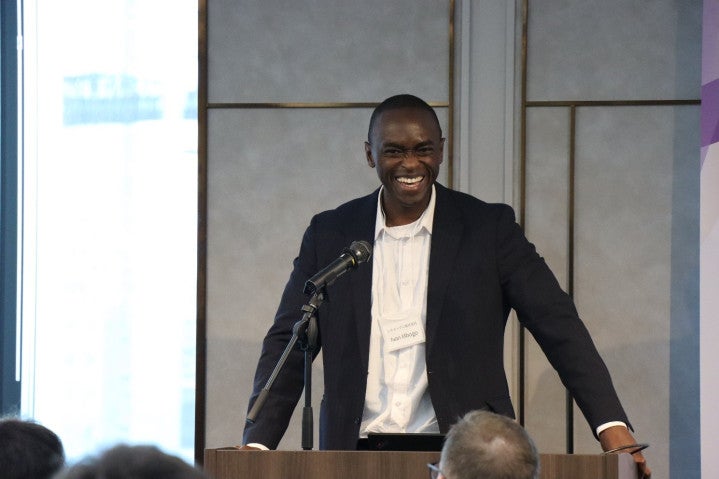
Dr. Ivan Mbogo, an OIST alumnus, discusses the skills gained through doctoral training that are highly valued by companies. (Photo credit: NAIST)
The panel discussion that followed centered on how Japan can better leverage international PhD talent to strengthen its global competitiveness. It brought together frank perspectives from across recruitment, development, and institutional collaboration. Panelists challenged the notion of “matching” as a one-time hiring decision, emphasizing instead the importance of long-term environments where individuals can grow, adapt, and demonstrate their value through sustained engagement between industry and academia.
Discussions highlighted the need for more companies to genuinely value international PhD talent, as well as clearer growth pathways and participation in decision-making. Participants also stressed the importance of starting with small, practical initiatives, sharing concrete examples, and promoting two-way talent circulation—welcoming international researchers while encouraging Japanese students and researchers to gain experience abroad. By the end of the session, diverse viewpoints had converged around a shared goal: building a society that nurtures and activates talent over the long term.
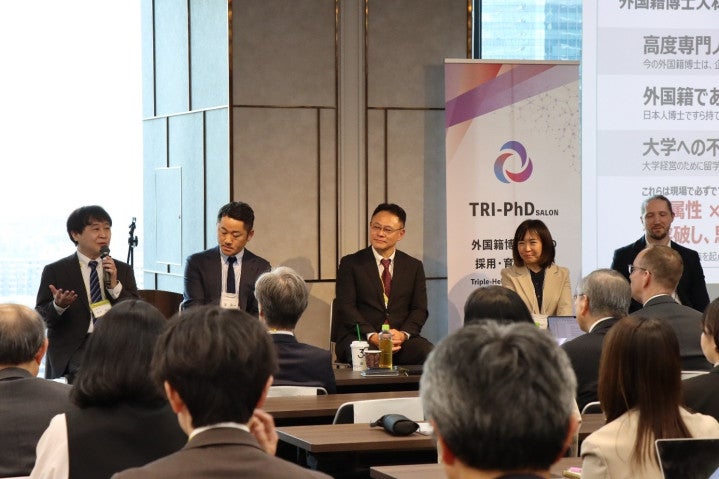
A panel discussion featuring lively exchanges on strategies to enhance Japan’s international competitiveness through the active engagement of international PhD talent. (Photo credit: NAIST)
A Tangible Shift in Mindset
In the concluding remarks, Dr. Caroline Benton (Board Director, NAIST) highlighted structural challenges facing PhD talent in Japan, including low doctoral participation rates, language barriers, information access, institutional constraints, and transitions to employment. Particularly notable was her emphasis on the lack of adequate support across the before, during, and after stages of studying in Japan, as well as the often-unconscious exclusion of international talent from decision-making processes.
In the closing address, Dean Thomas Busch (OIST) underscored that international PhD talent comes to Japan not only to study, but with a strong desire to contribute to society, the economy, and the innovation ecosystem. Unlocking this potential, he emphasized, requires not only institutional reform but a fundamental shift in mindset across universities, industry, and government—one that embraces new approaches and is willing to take risks.
The symposium concluded with a networking reception, where lively exchanges continued among participants. In his closing remarks, Vice President Hirokazu Kato (NAIST) emphasized the importance of making progress step by step toward meaningful achievement, bringing the event to a fitting and inspiring close.
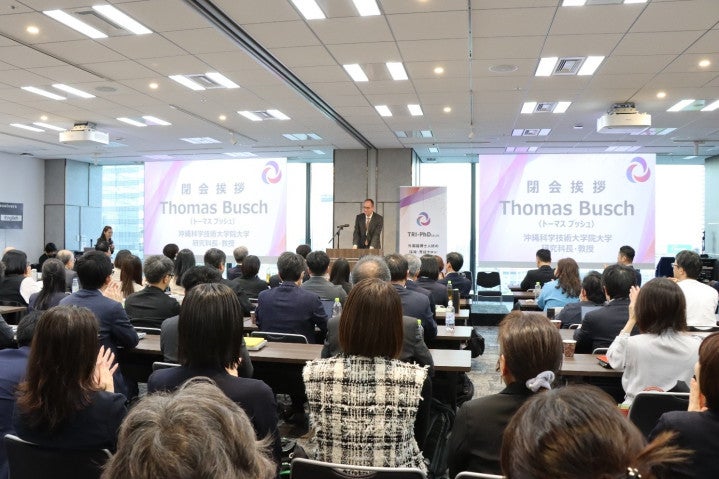
Thomas Busch, Dean of the Graduate School at OIST, speaks on the importance of a mindset shift. (Photo credit: NAIST)
From conviction to conversation, from dialogue to direction—
the TRI-PhD SALON Kick-off Symposium marked a decisive first step. Starting with international PhD talent as its focal point, the salon has begun to establish itself as a space for experimentation and implementation, aimed at mobilizing Japan’s innovation capacity.
This initiative strongly resonates with the mission of J-PEAKS, which seeks to create a virtuous cycle connecting research excellence, human capital, and societal impact. By translating bottom-up, university-driven efforts into industry–academia–government collaboration, TRI-PhD SALON embodies the very model of next-generation research capacity development that J-PEAKS envisions.
See the details of TRI-PhD SALON: https://www.naist.jp/oist/tri-phd/


